Is XRP Poised To Replace SWIFT As Global Payments Infrastructure?

bitcoinistPublished on 2026-02-08Last updated on 2026-02-08

Abstract

The article examines the potential for XRP and Ripple's payment infrastructure to replace the SWIFT network as the global standard for cross-border payments. It highlights SWIFT's limitations in real-time settlement and discusses a significant shift towards faster, digital financial systems. Crypto analyst Archie suggests SWIFT is now testing integration with the XRP Ledger, mimicking Ripple's approach. Analysts speculate that if XRP captures even a small portion of SWIFT's massive annual transaction flow, its value could surge dramatically, with some predictions reaching over $3,000. The piece also draws parallels between XRP's current market cycle and its historic 2016-2018 breakout, noting similar price consolidation and indicator patterns that may signal another major bull run. The integration of Ripple's stablecoin, RLUSD, into core banking platforms is further bridging crypto and traditional finance.

For decades, SWIFT has served as the backbone of global payments, enabling banks to message one another across borders but not to settle value in real time. As global commerce becomes faster, more digital, and more interconnected, the limitations of legacy messaging-based systems are becoming increasingly visible. This has brought renewed attention to XRP and Ripple’s payment infrastructure that aims to enable near-instant, low-cost settlement of value.

From Bank Messaging To Real-Time Settlement Rails

A massive 1.5 quadrillion financial shift is quietly unfolding, and it’s already shaking the foundations of global banking. Crypto analyst Archie has mentioned on X that SWIFT, the decades-old backbone of cross-border payments, is copying Ripple’s playbook for a real-time transfer system and testing the XRP Ledger integration that could flip the script on slow, outdated cross-border payments.

Meanwhile, analysts are suggesting that if XRP captures even a fraction of SWIFT’s estimated $150 trillion annual flow by 2030, the upside could be enormous, while some stated that the altcoin might surge to $3,000+. With Ripple’s RLUSD stablecoin integrating directly into core banking and treasury platforms, the bridge between crypto rails and fiat liquidity is rapidly taking shape.

Currently, there’s a speculation that XRP is being reviewed as a full SWIFT replacement in the US document, and trillions are flowing into the XRP Ledger. Meanwhile, banks like Citi are tokenizing, and Ripple technology is capable of leading the charge. Archie believes that Citi is already somewhere running on Ripple technology.

How The Last Major XRP Breakout Took Shape

A side-by-side comparison chart of XRP’s historical and current market cycles suggests that history may be rhyming once again. Analyst Archie has also pointed out that in the 2016 to 2018 cycle, the price started trading at a low level around $0.003, gradually building along a rising trendline, then dipping in the orange box, before the price exploded to highs near $3.50.

During that period, the Relative Strength Index (RSI) formed a clear low around the 50 level, signaling a momentum reset rather than a breakdown. The current 2025 to 2027 cycle is showing a structurally similar pattern. XRP is consolidating around the dollar mark, following a similar trend line, with a dip marked in an orange box to $0.70, and the formed bottom closer to the 40 mark.
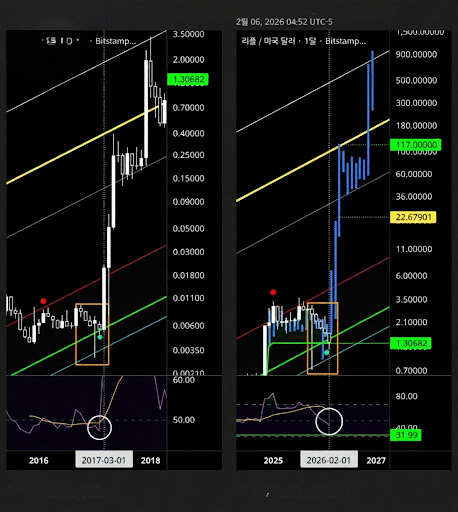
Source: Chart from Archie on X

Archie noted that the patterns in price action, the dips, and the indicator signals across cycles are repeating almost identically. While history never repeats perfectly, these recurring fractal patterns suggest that XRP may be priming for an epic bull run phase, from fractions to dollars, now potentially from dollars to triple digits, like the projected $117 range. Archie is bullish because the riddlers were right all along, and believes Phoenix will rise.

XRP trading at $1.40 on the 1D chart | Source: XRPUSDT on Tradingview.com

Related Questions

QWhat is the main limitation of the current SWIFT system that XRP and Ripple aim to address?

ASWIFT enables banks to message one another across borders but does not settle value in real time, whereas XRP and Ripple's payment infrastructure aims to enable near-instant, low-cost settlement of value.

QAccording to the analyst Archie, what significant development is SWIFT undertaking regarding the XRP Ledger?

ASWIFT is copying Ripple's playbook for a real-time transfer system and testing the XRP Ledger integration to improve slow, outdated cross-border payments.

QWhat potential price target for XRP is mentioned if it captures a fraction of SWIFT's annual flow by 2030?

ASome analysts suggest that if XRP captures a fraction of SWIFT's estimated $150 trillion annual flow by 2030, the altcoin might surge to $3,000 or more.

QHow does the current market cycle for XRP (2025-2027) compare to its 2016-2018 cycle, according to the analysis?

AThe current cycle is showing a structurally similar pattern: XRP is consolidating around the dollar mark, following a similar trend line, with a dip to $0.70, mirroring the previous cycle where the price built along a trendline before exploding to highs near $3.50.

QWhat role does Ripple's RLUSD stablecoin play in the broader financial ecosystem, as mentioned in the article?

ARipple's RLUSD stablecoin is integrating directly into core banking and treasury platforms, which is rapidly building a bridge between crypto rails and fiat liquidity.

Related Reads

Behind the 2000 BTC Incident: The Fundamental Problem of CEX Ledgers

On February 6, Korean crypto exchange Bithumb mistakenly distributed 2,000 BTC (worth approximately $1.6 million at the time) to each of 249 users due to a unit configuration error in a promotional event, instead of the intended 2,000 KRW (about $1.4). The total erroneous distribution amounted to 62,000 BTC, with a notional value of $41.5–44 billion, far exceeding Bithumb’s actual Bitcoin holdings of 42,600 BTC. Although Bithumb recovered over 99% of the misallocated funds within 35 minutes by freezing accounts and covering the remainder with company assets, the incident exposed a fundamental flaw in centralized exchanges (CEXs): their reliance on internal ledgers that are decoupled from on-chain assets. Unlike decentralized exchanges, where transactions occur on-chain, CEXs use internal databases to record user balances, allowing instant—but potentially unbacked—asset entries. This creates systemic risk, as seen in historical failures like Mt. Gox (where internal ledger mismasks hid massive theft) and FTX (where customer funds were secretly diverted). The event underscores the trust asymmetry in CEXs: users see balances as real assets, but they are merely IOU promises. The Korean Financial Supervisory Service has since launched inspections, signaling heightened regulatory scrutiny. Bithumb’s near-disaster serves as a critical reminder of the inherent vulnerabilities in CEXs’ accounting models.

marsbit2m ago

Behind the 2000 BTC Incident: The Fundamental Problem of CEX Ledgers

marsbit2m ago

Trading

Spot
Futures
活动图片